
A Landscape Painter's Guide to Using Nature, Not Imitating It - Easel Talk #43
Imagination Is King

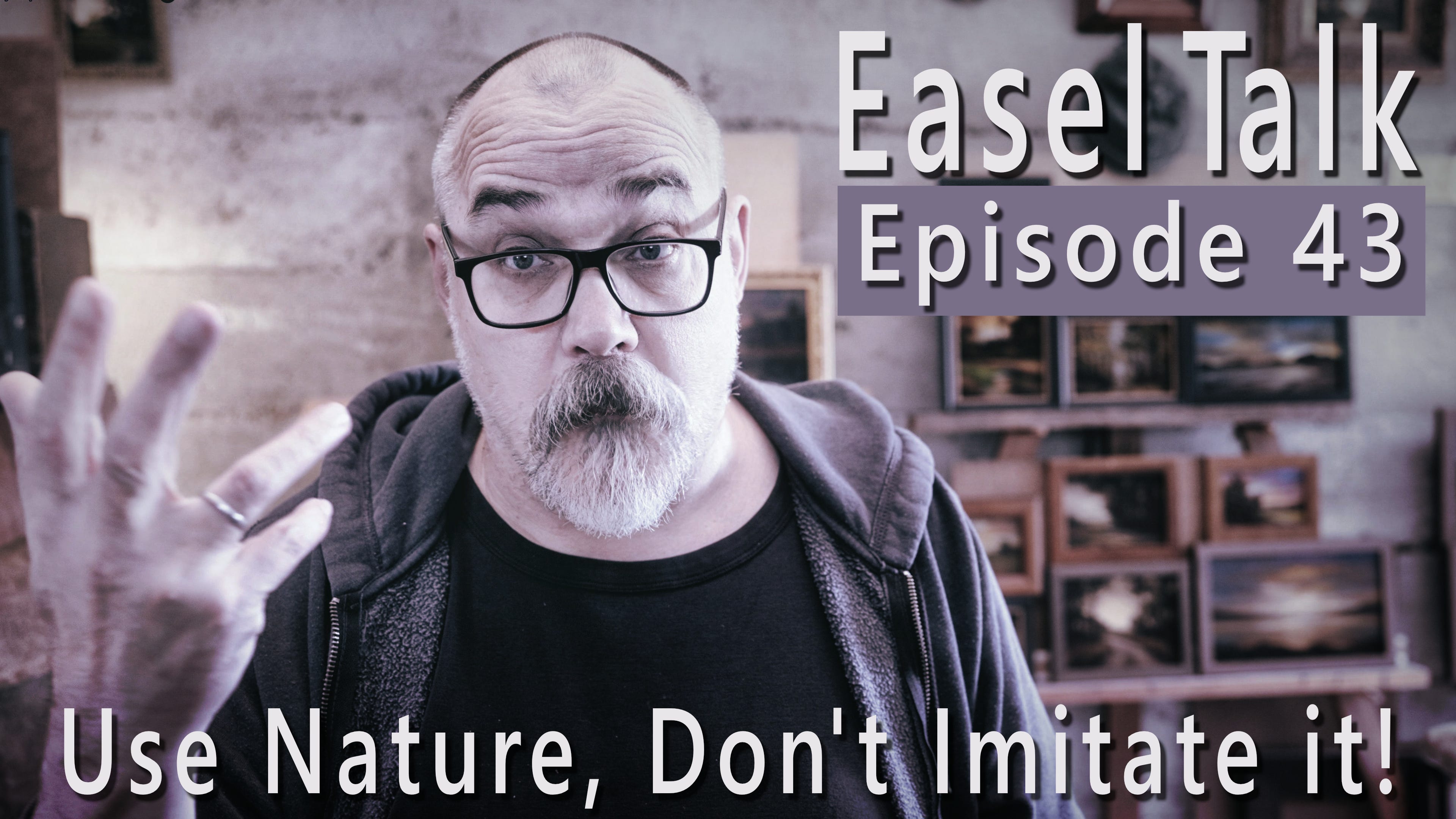
Welcome to Easel Talk 43. The topic for Easel Talk 43 is: Using nature, not Imitating it. This goes for reference photos, working plein air, whatever you’re trying to do.
Imagination Without Reference
In the absence of reference or working outside, you could just make paintings strictly from your imagination. I tried doing that when I first started. That was some goofy stuff. I was very surprised to find out that the landscapes coming out of my imagination without reference didn’t look very good.
If you close your eyes and try to visualize something, you’ll see that yes, you can pull things together, but the resolution is quite low. There’s not a lot of detail. Some people obviously are more gifted at that than others, but even gifted people, the ability to really come up with a cohesive scene just from your imagination, especially starting out, is limited.
Imagination Is King
Imagination is the single most potent and powerful force in our reality. When applied to any problem, situation, or artwork, it will be the primary difference between success and failure. You want to always find ways to open up your process to imagination so it can come in and do the harder work. Because when you’re working from imagination and inspiration, things go quite a bit better than when you’re trying to figure things out, plot every step.
When you’re compositing a landscape painting, your imagination should be foremost in your thoughts far more so than the technical questions or considerations. The technical problems usually will be naturally addressed during the painting process. Sometimes they can stab you, but that’s all part of it too. You’re not going to have the same problem repeatedly torment you.
I’m a positive person, and that’s how I operate. You want things great? Let the imagination lead. Imagination is king over the reference and over your linear ideas of how things should necessarily go.
Finding the Painting Within Nature
Finding the painting within nature, the scene versus the painting. With the right sort of outlook, just about any scene that presents itself to us could be fashioned into a painting. Many times, different outlooks will have to be entertained to find that ideal portrayal. Perhaps that involves a worm’s-eye view instead of a standard viewing position, or perhaps an extreme zoom in on the subject will be best.
A lot of times you’re out there and you think, “That would make a good painting.” I’m sure it’s happened to you too. That voice, that initial impetus, “This could make a good painting”, that’s really important. And that’s what you want to develop. You develop it by following through.
Sometimes it’s wrong, but what I found is that there probably is the genesis of a good painting in there, even if you took a crack at it and you made it fail. There were aspects of the reference that were absolutely awesome, but there were a lot of things in there that you had to ignore or avoid. And so often that’s based on just plain experience.
Lots of times I’ve found that things I thought could be made into a painting, I took the photo, but it couldn’t work. I couldn’t get it together, and it’s never made a painting. But a lot of times when I’m revisiting these now that I have a lot more experience, I think I know what to do. The path thing was a big part of that. There’s a zillion scenes I have that were just what I call “all in a row”, you got a path or a road coming in. That solves that problem beautifully, doesn’t it?
The Campbell Perkins Ponds Story
When I first started landscape painting, I went out with my Canon Powershot. I loved mine. It was killer tech of the day. Speaking about juicing up the reference, it kind of juiced things up in camera, boosting contrast, giving extra saturation, a little nice warm glow. They were great.
I used to ride my bike to work past the Campbell Perkins ponds, and they’re beautiful. Ponds and water, if you can get that into your landscapes, is always great. You got a lot more interest, you got reflections, you’ve got more compositional variety.
My early attempts at painting were basically just making copies of the photos onto a canvas. Everything was looking okay, pretty good. They had a very photographic quality. I had illustration ability, technical chops, ability to render things like that. But I ran into limitations.
The problem with this sort of approach to painting, and this is a lot of people, you can get very good at making paintings from photos. Or you could be Mr. and Mrs. plein air, making your plein air paintings from scenes, and they’re just kind of blah, right? The missing component is your own unique perspective and zeitgeist. That’s what needs to be developed as you paint. The reference image itself is just grist for the mill. It’s just something to inspire the painting. That’s its proper place.
There’s not a lot of point in investing your time in becoming a human version of a camera, which is basically what I was doing. But what we want is something more. We want to get that stamp of your feeling that you’re getting from the landscape. We don’t need another photo in paint. Your take on things would be way more interesting.
Plein Air Painting
I did do some plein air painting early on. I made a painting and it wasn’t great. I still have it of course. You got to keep your first painting. But that was tough. It wouldn’t take me long to figure out that plein air wasn’t really for me.
I would have ideas about oh, I think that scene could paint up, and then wow, I just moved my head a little, everything’s changing. The shadows are moving, the light’s changing, oh a cloud came over. It’s endless, man.
The deeper question is: what is nature providing that you wouldn’t have access to otherwise, and is it important for me to have it instilled in my work? That’s the real killer question.
I tend to find working outdoors in nature frustrating and at odds with my goals. There’s many things discernible in nature that will not be in the photo. First of all, that whole range of greens, we can see 30 percent more green than any other color. The cameras take all that and say, “You got 30, 40 different greens here. I’m gonna give you eight.” You just copy those camera greens, which are dull, boring, and uninspiring.
So I use nature as a starting point, as a springboard of inspiration, rather than attempting to reproduce what I see. That’s not what I’m into. That’s not really tonalism.
Nature provides the forms, colors, and lighting, but it’s up to the artist to transform these elements through our imaginations into something great like a painting. That’s your job as the painter.
I Am Nature
I am nature. The studio conversations, nature is all around us as we are a part of it. Many times people come into my studio and see all the paintings with the trees and the skies and the ponds. They say, “You must love nature.” And I do. But what I really like to do is go out in nature, take my picture, and then come back here and paint it. That’s what I like to do.
George Inness said something that I’m paraphrasing: “I don’t need to go into nature to paint because I am nature itself.” And we all are. We are not separate from nature. You open your eyes, you look out through them, you’re moving through the world, however old or young you are. The world you see is essentially unique to you. It’s your perception of the world. Yes, we have a shared reality, but the experience of that reality is yours uniquely alone, and it is a natural process, and you are nature itself. Absolutely a fact.
So I’m not saying don’t go out in nature, don’t take reference photos. Definitely, if you haven’t tried plein air painting, you should give it a try because I learned a lot. I really did. And I made one or two successful paintings that I sold.
The core truth: I am nature itself, not separate from nature in any way. When I move, nature moves. And when I’m still, nature is still. I don’t need to imitate nature because I am nature.
So when you’re painting along your process, just remember this: nature is inside you. And the reason I think Tonalism is so significant is because it’s not just like, “Hey, look at this interesting refraction of light that’s bouncing off of that and it’s hitting the other thing over there. I’m gonna paint that.” But tonalism brings in the actual feeling for the paint, the actual process of painting. It’s not just a means to an end. The paint, the brushes, the board, the easel, the studio, they’re all extensions of you, and by extension, nature itself. This sort of mindset is gonna open up things for you.
Make Something Every Day
Open yourself up to the possibilities of paint, and the best way to do that is by painting on a regular basis. Every day, really. Just make something every day. Big painting, small paintings, it don’t matter. Make them. Keep expressing yourself. Keep getting outdoors and taking photos.
There’s a lot of times my wife and I will be driving around. She said, “What about that?” Certain things I just know don’t work. There’s the “all in a row” thing, which she asked about. You can take the photo. There’s a really interesting composition of the tree shapes. You can bring in a foreground element. Done it. But one thing I think definitely doesn’t work now for me is like you’re standing up here and you’re looking down a view of a valley or whatever. You want to make sure that hills, trees, whatever, are breaking into the horizon. If your horizon is very too high to the point where you’re looking at nothing but hills and things and trees and nothing’s breaking through the horizon, usually that don’t work as a painting.
Simplify and Transform
Always work towards simplification. The reference has got too much going on. There’s five trees, make it two, three. There’s 15 branches overlapping the sky, it’s one or two now. There’s 100 sky holes, make it one. Just like Georgia O’Keeffe. Simplify. Change colors. Emphasize what matters to you and let go of what doesn’t work.
This is where the painting becomes yours, not nature’s, because you’re going to use nature, not imitate it.
Imagination first principle. It’s all about you, your imagination, expressing yourself. And you want to get good at doing that of course you do, because it’s a buzz, man. It’s great. If you have that affinity with painting, then get on the horse and start painting. Just make a painting every day. Don’t get too hung up on is this good, is this bad? You’ll start to know.
Make your paintings every day, and what you’ll see is that your imagination will be able to come to the floor, and your style will start coalescing. You’ll focus on the thing that moved your heart, and that’s the thing you’re going to communicate to other people’s hearts.
When you lead with the imagination, the technical problems tend to resolve themselves. You just paint your way through them, relying on imagination to carry the day, again and again and again. And the next thing you know, you got a style. You got a body of work. And you’re up and running.
Mike’s New Site | Substack | Painting Website | Mailing List | Store | My Music | Support | Members Area